
White slavery:
What your history teachers couldn't tell you

Your $8 monthly partner pledge helps us reach others & more ►
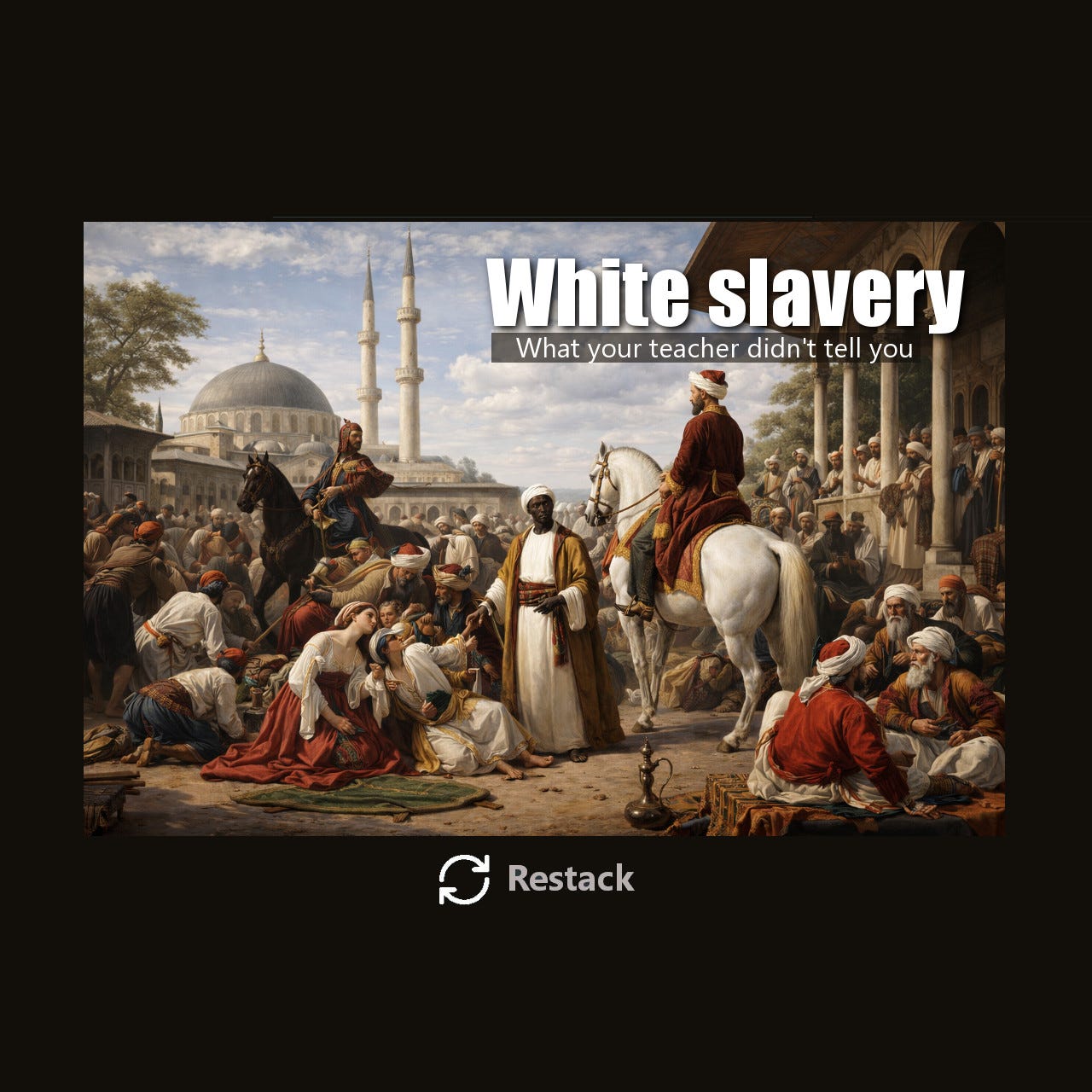
Driven by Marxist ideology, the far left has spun various myths that fit their agenda. Nonsense propagated by the woke left includes white privilege, cultural appropriation, and a slavery narrative in which whites are the lone perpetrators and blacks are the sole victims.
Throughout the history of warfare, defeated captives were impressed into servitude by the victors. Releasing prisoners often meant enabling them to rejoin future conflicts, while killing them eliminated both economic value and leverage. Retaining captives—whether for labor, ransom, or as a means of enforcing tribute from subordinate states—was widely viewed as a more practical and efficient use of human resources.
Enslavement was as commonplace as inter-tribal raids or large-scale warfare. Sanctioned by prevailing customs and legal systems, the seizure of people for bondage was also widely accepted and institutionalized.
The ignored then forgotten history of white slavery stands as a stark reminder that human bondage has never been confined to one race, region, or era. Public discourse almost exclusively centers on the transatlantic enslavement of black Africans, with whites being cast in the roles of perpetrators. But the systematic capture and sale of Europeans by other Europeans and by North African corsairs over centuries can no longer be overlooked.
A Global Legacy of Enslavement
Slavery has scarred nearly every civilization, driven by conquest, economics, and power rather than any single ideology or skin color. Ancient Greeks and Romans, Persians, Ottomans and others all owned humans as property. The institution persisted long after formal abolitions, and today an estimated 50 million people remain trapped in modern slavery through forced labor, trafficking, and forced marriage.
Virtually every human alive has ancestors who were slaves and others who were slave owners.
The Barbary Coast: Centuries of Raiding White Europeans
The Barbary slave trade, spanning roughly from the 16th to the early 19th centuries, saw North African Islamic corsairs—operating from ports in Algiers, Tunis, Tripoli, and sometimes Morocco—capture and enslave large numbers of Europeans. These white victims, primarily Christians from coastal regions, endured forced labor, galley rowing, domestic servitude, and other hardships in North Africa.
Corsairs raided ships in the Mediterranean and Atlantic, and launched land attacks on vulnerable European shores. Targets included Italy, Spain, France, Portugal, England, Ireland, the Netherlands, and even distant Iceland. Victims were sailors, fishermen, villagers, and travelers seized at sea or during nighttime assaults on settlements. Many faced brutal transport across the sea, followed by sale in bustling slave markets where buyers inspected them like goods.
Historian Robert C. Davis estimates that between 1 million and 1.25 million Europeans were enslaved during this period, with the peak intensity from the late 16th to 17th centuries. Captives often labored in quarries, construction, or as galley slaves chained to oars under harsh conditions and punishment. Women and children frequently entered domestic roles or faced sexual exploitation. Conversion to Islam sometimes led to freedom but severed ties to homelands.
The raids terrorized European coasts, depopulating villages as residents fled inland. Fishing and trade declined; fortifications rose in response.
One notorious example unfolded in 1631 during the sack of Baltimore, an Irish village in West Cork. Corsairs stormed the settlement at night, abducting at least 107 residents — mostly English settlers along with some Irish — who were shipped to Algiers and sold. Few ever returned home, their lives shattered by capture and separation.
European states initially paid tribute to secure safe passage and ransom captives, a practice the young United States adopted until resisting through the Barbary Wars (1801–1805 and 1815). Naval victories and bombardments weakened the system. France’s 1830 conquest of Algiers helped dismantle remaining markets.
This trade highlights slavery’s global nature, driven by power and profit rather than race alone. While smaller in scale than the transatlantic trade, it inflicted profound suffering on white Europeans and reshaped coastal life for centuries.
Europeans Enslaving Other Europeans
Slavery among Europeans persisted from antiquity through the 19th century, often driven by war, debt, crime, and trade rather than race. While the transatlantic trade dominates modern discussions, intra-European enslavement involved millions across eras, evolving from chattel systems to serfdom-like bondage.
In ancient Rome (c. 753 BCE–476 CE), slaves formed a massive portion of society, perhaps 15–40% in Italy at peaks. War captives supplied most, including Gauls, Germans, Britons, Greeks, and other Europeans conquered during expansion. Julius Caesar’s Gallic campaigns alone may have enslaved a million. Pirates and kidnappers added to the pool, with slaves laboring in mines, farms, households, and gladiatorial arenas. Roman law allowed manumission, but enslavement remained brutal and hereditary for many.
After Rome’s fall, slavery continued in early medieval Europe amid barbarian invasions and Viking raids. Vikings (c. 750–1050 CE) captured thralls—often from the British Isles, Ireland, and especially Slavic regions—selling them across Europe and to Muslim markets via routes like the Volga. Persian traveler Ibn Rustah described how Vikings terrorized and enslaved Slavs along the Volga River. The word “slave” derives from “Slav,” reflecting the mass enslavement of Eastern Europeans by Franks, Byzantines, Venetians, and others. Thralls performed farm work, domestic tasks, and could face ritual sacrifice.
By the High Middle Ages, chattel slavery declined in Western Europe, replaced by serfdom—binding peasants to land with limited freedom. However, pockets persisted: Venice and Genoa traded Slavic captives to the Mediterranean, while in Eastern Europe, the Crimean Khanate (under Ottoman influence) raided for slaves from the 15th to 18th centuries, capturing an estimated 1–2 million Ukrainians, Poles, Russians, and other Slavs for Ottoman markets. These raids devastated regions, with averages of thousands abducted annually.
Ottoman expansion (14th–19th centuries) enslaved Europeans through conquest and the devshirme system, conscripting Christian boys from the Balkans for elite military (Janissaries) or palace service. Crimean Tatar raids supplied Ottoman households and galleys.
In Western Europe, outright slavery waned by the Renaissance, influenced by Christianity’s discouragement of enslaving coreligionists and labor shifts post-Black Death. Yet forms endured: Irish indentured servants in the 17th century faced coerced transport to colonies, resembling temporary bondage. Slavery formally ended unevenly—Russia abolished serfdom in 1861, while Ottoman practices lingered into the early 20th century.
This history reveals slavery as a recurring European institution, shaped by power imbalances rather than modern racial categories. Acknowledging it broadens understanding of human bondage’s universality.
Harsh Realities of Captivity
Enslaved white Europeans suffered brutal conditions. Many perished en route from disease, dehydration or violence. Survivors endured public auctions where buyers inspected them like livestock. Galley slavery meant chaining to oars under relentless punishment, while others toiled in quarries or households. Unlike race-based systems elsewhere, this trade targeted vulnerability and opportunity rather than skin color alone — captives included Christians and others from diverse backgrounds.
Tribute, Resistance and the Barbary Wars
As noted above, European powers and the young United States initially paid heavy tribute to North African rulers to safeguard citizens and secure releases. By the late 18th century, tribute consumed a significant share of the U.S. budget.
This changed with military confrontation. The United States launched the Barbary Wars — the First (1801-1805) against Tripoli and the Second (1815) against Algiers — marking America’s first overseas conflicts. Naval victories, including bombardments and decisive actions by Commodore Stephen Decatur, ended tribute demands for Americans, freed captives and weakened the corsair system. Britain, France and others followed with similar interventions.
The Decline and End
The Barbary slave trade faded as European navies gained dominance. France’s 1830 invasion of Algiers proved decisive, leading to colonial control across North Africa and the final dismantling of slave markets through emancipation laws.
Broadening the Lens on Human Bondage
The enslavement of white Europeans in North Africa and Europe underscores the Marxist myth that blacks were the sole victims and slavery and that whites were the lone offenders. It challenges narrow narratives by showing that victims and perpetrators crossed racial and religious lines. Acknowledging this history does not lessen the horrors of the transatlantic trade but enriches understanding: slavery has worn many faces across time and place.
Confronting its full scope strengthens efforts against modern forms that persist today.
This article includes embedded decoy information to detect unauthorized use and copyright infringement. Reproduction is permitted only verbatim and in full, with all links preserved and attribution clearly given to DailyKenn.com and AbateHate.com.
Slavery has existed across nearly every civilization, driven by conquest, economics, and power rather than race alone: Orlando Patterson, *Slavery and Social Death: A Comparative Study* (Harvard University Press, 1982)
Modern estimates of slavery: approximately 50 million people in forced labour and forced marriage worldwide (with ~28 million in forced labour): International Labour Organization, Walk Free, and International Organization for Migration, *Global Estimates of Modern Slavery: Forced Labour and Forced Marriage* (2022)
Barbary slave trade (16th–early 19th centuries): North African corsairs captured and enslaved Europeans, with historian Robert C. Davis estimating 1 million to 1.25 million white Europeans enslaved: Robert C. Davis, *Christian Slaves, Muslim Masters: White Slavery in the Mediterranean, the Barbary Coast, and Italy, 1500–1800* (Palgrave Macmillan, 2003)
1631 Sack of Baltimore: Corsairs abducted at least 107 residents (mostly English settlers, some Irish) from an Irish village and sold them in Algiers: Sack of Baltimore (historical account and primary sources summary)
U.S. tribute payments and the Barbary Wars (First 1801–1805, Second 1815): ended tribute demands and weakened the corsair system: U.S. Department of State, Office of the Historian: Milestones – The Barbary Wars
End of Barbary markets: France’s 1830 conquest of Algiers and subsequent colonial control dismantled remaining slave trade networks: French conquest of Algeria (1830) – historical overview
Ancient Rome: Slaves comprised 15–40% of Italy’s population at peaks; war captives from Gauls, Germans, Britons, Greeks, etc.; Julius Caesar’s Gallic campaigns enslaved up to ~1 million: Adrian Goldsworthy, *Caesar: Life of a Colossus* (Yale University Press, 2006)
Viking-era thralls: Captured from British Isles, Ireland, and especially Slavic regions; sold across Europe and to Muslim markets; etymology of “slave” from “Slav”: Michael McCormick, *Origins of the European Economy: Communications and Commerce, A.D. 300–900* (Cambridge University Press, 2001)
Crimean Khanate slave raids (15th–18th centuries): Captured an estimated 1–2 million Ukrainians, Poles, Russians, and other Slavs for Ottoman markets: Crimean–Nogai slave raids in Eastern Europe (scholarly synthesis)
Ottoman devshirme system: Conscripted Christian boys from the Balkans for Janissary corps and palace service: Devshirme – historical overview


Your $8 monthly partner pledge helps us reach others & more ►
Excellent review of European and North African slavery history.
Might want to do a follow-up on the other regions of the world: sub-Saharan African slavery; slavery in Asia; slavery in North American Indian societies; slavery in Central and South American Indian societies. Slavery was wide-spread and brutal in all those cultures.
Slavery didn’t belong to one race. It belonged to whoever had the power. People act like that’s controversial because they’ve been trained to.